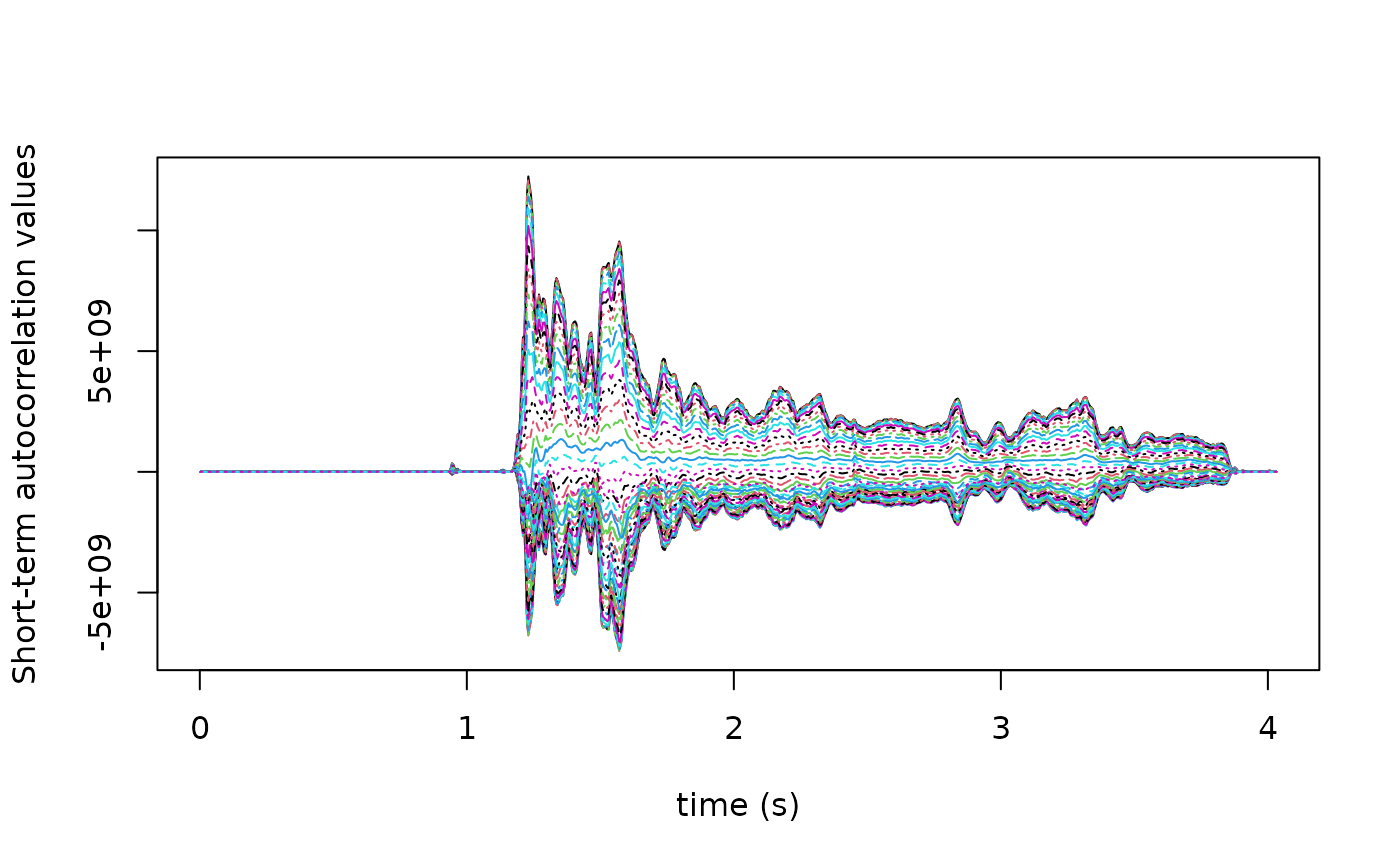
Track short-term autocorrelation function
trk_acf.RdComputes the short-term autocorrelation function (ACF) of audio signals
using the libassp C library (Scheffers 2012)
. Useful as a
front-end feature for voicing detection and LP-based analysis. Prefer
trk_acf over manual lag computation when frame-synchronous output
in SSFF format is needed.
Usage
trk_acf(
  listOfFiles,
  beginTime = 0,
  centerTime = FALSE,
  endTime = 0,
  windowShift = 5,
  windowSize = 20,
  effectiveLength = TRUE,
  window = "BLACKMAN",
  analysisOrder = 0,
  energyNormalization = FALSE,
  lengthNormalization = FALSE,
  toFile = FALSE,
  explicitExt = "acf",
  outputDirectory = NULL,
  assertLossless = NULL,
  logToFile = FALSE,
  keepConverted = FALSE,
  convertOverwrites = FALSE,
  verbose = TRUE
)
Arguments
- listOfFiles
Character vector of audio file paths. Any format supported by av is accepted; non-native inputs are transcoded automatically.
- beginTime
Numeric. Start of analysis window in seconds. Default 0 (file start).
- centerTime
Numeric or logical. Single-frame analysis time point in seconds; overrides
beginTime,endTime, andwindowShift. DefaultFALSE.- endTime
Numeric. End of analysis window in seconds. Default 0 (file end).
- windowShift
Numeric. Frame shift in milliseconds; sets output frame rate (1000 / windowShift Hz). Default 5 ms.
- windowSize
Numeric. Analysis window size in milliseconds. Default 20 ms.
- effectiveLength
Logical. Make window size effective rather than exact. Default
TRUE.- window
Character. Analysis window function type. Default
"BLACKMAN". See AsspWindowTypes for supported types.- analysisOrder
Integer. Number of lag coefficients per frame.
0sets order to sample rate in kHz + 3 (e.g. 19 for 16 kHz audio). Default 0.- energyNormalization
Logical. Compute energy-normalised ACF. Default
FALSE.- lengthNormalization
Logical. Compute length-normalised ACF. Default
FALSE.- toFile
Logical. If
TRUE, write SSFF output files and return the count written (invisibly). IfFALSE, return anAsspDataObj. DefaultFALSE.- explicitExt
Character. Output file extension. Default
"acf".- outputDirectory
Character. Directory for output files.
NULL(default) writes alongside the input file.- assertLossless
Character vector of additional file extensions to treat as losslessly encoded.
- logToFile
Logical. Write processing log to a file in
outputDirectoryrather than the console. DefaultFALSE.- keepConverted
Logical. Retain intermediate transcoded files. Default
FALSE.- convertOverwrites
Logical. Allow transcoding to overwrite existing files. Default
FALSE.- verbose
Logical. Print per-file progress. Default
TRUE.
Value
If toFile = FALSE: an AsspDataObj with track:
ACFREAL32, dimensionless, n_frames x
analysisOrdercolumns. Autocorrelation coefficients at lags 0 … analysisOrder-1.
Frame rate: 1000 / windowShift Hz (default 200 Hz).
If toFile = TRUE: integer count of files written, returned invisibly.
Details
analysisOrder = 0 selects an order equal to the sample rate in kHz + 3.
Energy normalisation divides each frame's ACF by its lag-0 value.
Length normalisation divides by frame length. Both can be combined.
References
Scheffers M (2012). “Advanced Speech Signal Processor.” https://sourceforge.net/projects/libassp/files/libassp/.
Examples
# get path to audio file
path2wav <- list.files(
   system.file("samples", "sustained", package = "superassp"),
   pattern = glob2rx("a1.wav"), full.names = TRUE)

# calculate short-term autocorrelation
res <- trk_acf(path2wav, toFile=FALSE)
#> Applying `method(trk_acf, class_character)()` to 1 recording

# plot short-term autocorrelation values
matplot(seq(0, n_records(res) - 1) / sample_rate(res) +
        attr(res, 'startTime'),
        res$ACF,
        type='l',
        xlab='time (s)',
        ylab='Short-term autocorrelation values')